
Best Practice
How to maximise your use of Maths-Whizz
There can be approximately a 4-year knowledge gap between the highest and lowest attainers in any class.
The Maths-Whizz tutor was created to address this problem by providing a personalised learning experience.
The first step is to identify knowledge gaps. All students complete an in-depth assessment, which allows teachers to easily evaluate where individual students are concerning their maths knowledge and plan the best approach to help them move forwards. This only takes approximately 45 minutes to an hour.

The initial assessment should be..
Completed at School NOT at home
This avoids any helpful parent being too supportive! No support should be given at this stage and students can click "don't know yet” if they are stuck.
Completed independently
The purpose of the assessment is to give the Tutor an accurate understanding of the student's knowledge. Do not answer questions for them - the Tutor needs to work out the student’s Maths Age not yours
Completed in one or multiple sittings
Depending on time and the students. Their progress will be saved if they do take a break
Once the assessment is complete…
Maths-Whizz is designed to make teachers’ workload easier. The steps below will help you to embed Maths-Whizz and get actionable insights to support your students instantly.
THE TUTOR
Students acquire core knowledge through an individualised learning journey
Scheduling - Consistency is crucial
When learners form consistent habits to complete learning tasks, the likelihood of knowledge retention, learner engagement and transfer of learning rises.
- Schedule when the students will be using Maths-Whizz. This will be 60 minutes of individualised tutoring a week (up to 90 minutes for low attaining or SEND students)*. Worth allowing additional time for logging on and off. *Each week all students should achieve at least 3 Progressions and 3 Ruby Red gems to fully benefit.
- Finding 60 minutes can be challenging but the time can be broken into smaller manageable chunks of 20 minutes. The Tutor saves the lesson and question they are completing, so they don’t have to start again.
- Factor availability of appropriate devices, access to internet and home usage.
- Share the timetable with the teachers/ HTLA/ LSA / students and ensure they know what is expected during this time.
- Be consistent – make sure it happens


How can Maths-Whizz fit into the weekly timetable?
You could utilise:
- Maths lesson time – one activity part of a planned carousel of activities
- Lunchtime clubs
- Maths club
- The fifth maths lesson in the week often used for consolidation
- Registration time – morning and afternoon
- Before or after school clubs
- Intervention time/ workshops
- Additional assembly or extra-curricular activity time
- Homework time if students have devices at home
MONITOR
Students acquire core knowledge through an individualised learning journey
Track every student’s progress at-a-glance.
Allocate time weekly to monitor the progress of students in Reports. This enables you to act immediately to identify individual learning needs, track progress, and intervene where necessary to maximise student success.
- Use Usage and Progressions to track each student’s progress. This can be viewed at class and school level as well.
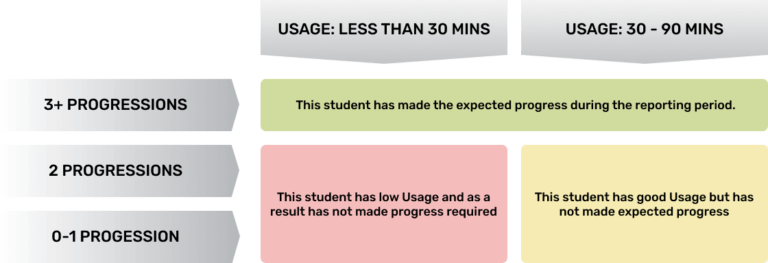
- Use the Detailed table view to understand why some students might be struggling. Check their Progression Pass Rate – below 70% could be a cause for concern. Average Exercise and Test Mark should be above 60%. Most of their Usage should be in Tutor not Topic Challenge unless there is a focus on consolidation of learning.
- Review your class data weekly. The table can help to filter students and identify actions. The comments refer to the reporting period set.

ACT
on insights by applying a range of instructional strategies
Track every student’s progress at-a-glance.
Acting on data is essential for informed decision-making and effective course correction, as it provides valuable insights into the ongoing performance and areas that require attention. By regularly analysing and acting on progress data, you can optimise the strategies you use and improve outcomes.
- Create reward systems (e.g. Certificates) to motivate consistent, week-on-week use of Maths-Whizz. Always reward Progressions alongside Usage!
- Follow up with students whose Usage is below the target you have set them.
- For consolidation, encourage Topic Challenge for students who have achieved 3 Progressions to then achieve three Ruby Red gems and use range of resources in Teachers’ Resource.
- Set Topic Focus to provide differentiated support within a chosen topic area.
- Review Usage Schedules -do the students have enough time alloacated to complete exercises/tests in one session
Provide intervention for students who are struggling and use their Lesson History to uncover specific knowledge gaps.

When should I use Topic Focus?
You could utilise:
- Complementing what is currently being taught in the daily maths lesson
- Pre-teaching – prepare students on what is going to be taught
- Consolidating the learning in the lesson
- Homework assignments
- Revision just prior to exams
- Re-visiting previously taught topics

Leader/Teacher engagement
Active involvement of school leadership is essential in fostering a positive learning environment and implementing fidelity.
For successful implementation, stakeholders must be clear on
- why Maths-Whizz is being used,
- what it entails,
- who will use it,
- where and when it will be employed,
- how it will be monitored, and
- a focus on consistent data utilisation and ensuring engagement from students, teachers, and parents.

Parental Engagement
Maths-Whizz gets the best results with well informed teachers who schedule time for students to use Maths-Whizz, know how to view the online reports, and who engage parents to support Maths-Whizz use out of school.
Parental involvement in Maths-Whizz is vital as it enables parents to stay informed about their child’s progress and actively participate in their mathematical education. By engaging with the platform, parents can better support their children’s learning journey, leading to improved maths proficiency and academic achievement.

Here are few recomendations for engaging with parents:
Send a letter home to parents informing them about Maths-Whizz, how it is being utilised in the classroom. Provide parents with website details and student login information.
Send a letter home to parents inviting them to a Maths-Whizz Parents Evening.
Invite parents to a "Family Maths Night" where the focus is Maths-Whizz. Allow the students to show their parents what they are working on and how it works. This should take place after the students have been using it for a while and know about the features - maybe the 3rd week of school/implementation.

The diagram shows the ideal dynamic between teachers, students and their parents to ensure that Maths-Whizz Tutoring helps to raise standards in maths